Most conflict of interest tools ship with a fixed template and call it a day. Compliance teams then spend months forcing their actual policies into someone else's boxes.
Rigid, out-of-the-box COI disclosure forms rarely match how a real organization actually assesses risk across gifts, hospitality, outside employment, and third-party relationships. When the workflow can't adapt to local regulations, business units, or evolving risk thresholds, compliance teams end up building workarounds in spreadsheets, right back where they started.
GAN Integrity buyers choose configurability that bends to their compliance program instead of forcing their program to bend to the software, all while keeping COI disclosures connected to the same third-party risk data compliance teams already rely on.
The Problem With One-Size-Fits-All COI Templates
Conflict of interest programs look deceptively simple from the outside: send a form, collect a disclosure, review it, done. In practice, a global manufacturer, a regional bank, and a mid-market SaaS company each need very different questions, escalation paths, and approval chains. A fixed template forces every one of them into the same shape.
That mismatch shows up fast. Teams start maintaining side spreadsheets to track exceptions the software can't handle, or they ask IT for custom development just to add one new question to a disclosure form. Neither option scales, and both add risk exactly where the program is supposed to reduce it.
Buyers evaluating alternatives consistently point to this gap. They want a platform that treats COI as one connected vertical among many, not an isolated form builder bolted onto a bigger suite.
Built to Customize Every Workflow, Not Just the Intake Form
GAN Integrity's configurability extends past the disclosure form itself. Reviewers describe entire compliance verticals, COI, gifts and entertainment, e-learning, investigations, and third-party due diligence, being tailored together so the workflows reflect how the organization actually operates, not a generic best practice guess.
That matters most during implementation, when a compliance team is translating years of policy language into system logic. The ability to adjust escalation rules, approval chains, and risk scoring without waiting on a vendor's development backlog is what turns a COI tool from a static form into an operating system for ethics.
"They worked with us to customize every workflow covering all compliance verticals, this included COI, gifts, entertainment and hospitality, investigation, e-learning trainings, third party due diligence and investigations."
Executive Sponsor, Careem (G2 review)
Connecting COI Disclosures to Third-Party Risk Data
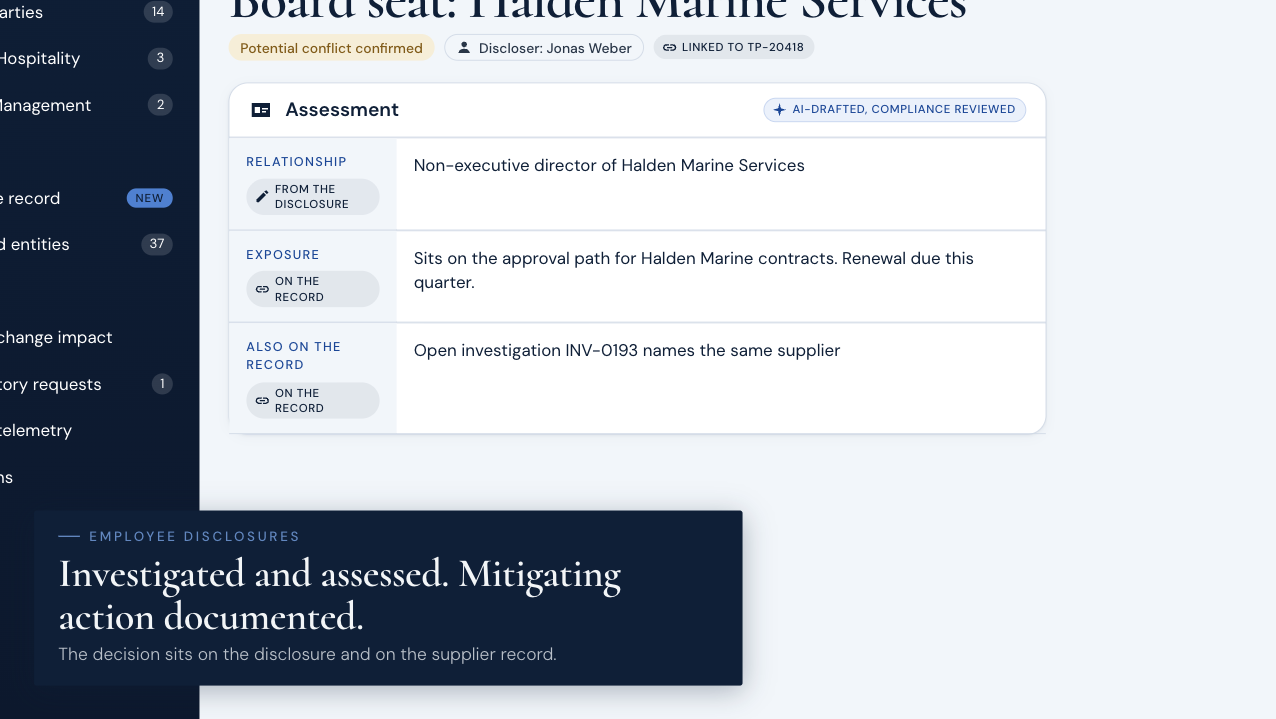
Conflicts of interest rarely exist in isolation. An employee's undisclosed financial interest in a vendor is also a third-party risk problem, and treating the two as separate systems means compliance teams lose the connective tissue between them.
This is where the platform's approach diverges most from point solutions built only for COI intake. GAN Integrity pairs disclosure management with due diligence controls, so a flagged conflict can be cross-referenced against the same third-party risk profile the organization already maintains for screening and monitoring. Reviewers highlight this holistic view as a direct driver of time and cost savings, since risks are caught and resolved before they compound into bigger problems.
For go-to-market and risk leaders comparing vendors, this integration point is often the deciding factor. A COI module that can't talk to third-party risk data is solving half the problem.
No-Code Flexibility That Keeps Pace With the Business
Regulations change, business units reorganize, and risk appetite shifts. A COI program built on rigid, code-dependent logic can't keep up without constant vendor tickets and delays.
Reviewers point to GAN Integrity's no-code foundation as the reason their programs stay current without a development team on standby. When a new regulation demands an additional disclosure question, or a business unit needs a different approval threshold, the change happens inside the platform, not in a backlog.
This flexibility also matters for organizations operating across jurisdictions, where a single global policy has to flex for local law without fragmenting into a dozen disconnected systems.
One Login, One System of Record
Compliance leaders don't just need flexible workflows, they need employees to actually use them. Reviewers repeatedly cite single sign-on integration with identity providers like Okta as a small feature with an outsized impact on adoption, since staff can reach COI disclosures, gift approvals, and due diligence tasks from the same login they use for everything else.
Combined with a centralized record of every disclosure, approval, and escalation, this removes the friction that causes employees to skip reporting altogether. A COI program only works if people actually file the disclosure, and access friction is one of the most common reasons they don't.
What Buyers Should Actually Compare
When you're evaluating a COI platform against the category incumbent, the questions worth asking go beyond feature checklists. Can the workflow logic be modified without a development cycle? Does the disclosure data connect natively to third-party risk and due diligence records, or does it sit in its own silo? Can the system flex for local regulatory variation without fragmenting your global reporting?
Reviewers rating GAN Integrity 4.5 stars or higher consistently answer yes to all three, and they describe the initial learning curve, an honest tradeoff of a highly configurable system, as manageable with the vendor's hands-on support during onboarding.
The result is a compliance function that moves from reactive form-processing to a strategic, connected view of risk across the organization.
"I now have a holistic view of risk. Automated workflows make compliance scalable while improving user experience. Overall, GAN Integrity is helping transform compliance into a strategic function."
Daniela A., Mid-Market (G2 review)
Key Takeaways
- Rigid, fixed COI templates force compliance teams into spreadsheets and workarounds; configurable workflows adapt to your actual policies instead.
- GAN Integrity customizes entire compliance verticals together, COI, gifts and hospitality, due diligence, and investigations, not just the intake form.
- Connecting COI disclosures to third-party risk data catches conflicts before they compound into bigger vendor risk problems.
- No-code configuration and single sign-on integration keep programs current and drive higher employee adoption.
- Buyers comparing vendors should evaluate workflow flexibility and TPRM integration, not just disclosure form features.
Choosing a conflict of interest platform isn't really about who has the prettiest disclosure form. It comes down to whether the system can flex with your actual policies and whether it connects that data to the broader third-party risk picture your organization already manages. Reviewers rating GAN Integrity 4.5 stars or higher point to exactly that combination: configurable workflows built with hands-on support, tied directly into due diligence and risk data, accessible through the same login employees already use every day.
See how configurable COI workflows work in practice.

Colin Campbell is Gan Integrity's VP of Marketing with over 15 years of experience in the SaaS software and tech industry. Colin has led analyst relations and product marketing growth strategies in North America, EMEA, UK and APAC, growing revenues in multiple industries. At GAN Integrity, Colin drives market expansion, demand generation and significantly enhancing customer retention, with a talent for aligning marketing strategies with business goals to deliver results.